On Life Changes
I just scrolled back to the beginning of this blog. It took some doing. I started Moments of Being on February 3, 2007. I had no idea I’ve been at this for more than decade. Like many of the paths I’ve taken in my writing life, it has been meandering, full of unexpected beauty as well as unanticipated challenges. It began accidentally and then I committed to it on purpose. Why did I start a blog, ten years ago? Because my publisher wanted me to. I had a book coming out — my novel Black & White — and a blog was the thing to do. I resisted. My publisher persisted. So I thought and thought about what I could blog about that would continue to feel interesting, both to me and to anyone who might read it. When I began, it was with some words about the creative process. What is it to grapple with the blank page, day after day, month after month, year after year?
My book Still Writing is entirely a result of having begun this blog. Not because I created the blog with the intention of turning it into a book someday. I did not. But people kept writing to thank me for the blog. They told me I was doing something useful. How often is a writer told she’s doing something useful? So I wrote Still Writing — never once looking back at what was on this blog. A blog is a blog, and a book is a book. They are different species, and require very different processes. For instance, when I’m finished writing here today, I will hit publish and be done with it. When I write a book, it takes years, as it should.
Those of you who follow me know that I haven’t really been keeping up Moments of Being. It has been languishing. I love it — but my time and energy have been moving in different directions. I’m not saying I’ll never post here again — but I suppose I’m hitting a pause button. I’ve been writing shorter and much more frequent mini-essays on Instagram, and I’d so love it if you’d follow me there. I find it’s a wonderful, warm community and a way of staying in regular touch. I’ve also created a show on Facebook called Office Hours — and now that I think of it, it’s very much an outgrowth of the ideas I’ve been developing here over the years. Facebook asked me to create a show, and I thought and thought — just as I did a decade ago. What can I talk about on a regular basis that will be exciting and inspiring to me, and to others? Once again I found myself wanting to delve deeper into the creative process. There is doing the work, and then there is thinking about what it takes to do the work. Both interest me enormously. If you follow me on Office Hours, you can ask me questions and I will try to answer the questions that seem to be of interest to the most people.

Publishing has changed enormously over the last decade — anyone who spends her life writing books will tell you this. The world is noisier. More is expected of writers. But ultimately as I write in Still Writing, a writer is someone who writes. I’m grateful to all of you who have been so kind and supportive of my latest memoir, Hourglass. I’m hard at work now on a new book that is taking everything I’ve got. So come say hi on Office Hours and on Instagram, and let’s continue the conversation!


On Productive Despair
It’s a beautiful day in New England. A cloudless sky, a rustling summer breeze that carries with it just the barest hint of autumn. My guys are downstairs reading (Michael’s reading The Year of Magical Thinking and Jacob’s reading All the Light We Cannot See) and I am taking a few minutes to relish the quiet, the early morning, my family together under one roof. In a little while, we will drive five minutes away to do yoga in a barn at an organic farm with friends and members of this community where we have lived for the past fifteen years. Life — today — I recognize, at this very moment, is beautiful.
And yet. (You knew the “yet” was coming, didn’t you?)
I am a writer trying to tell a story that is banging on my rib cage, coursing through my bloodstream, haunting my dreams. I didn’t choose this story. This story chose me. It’s the story that makes sense of all of my other stories, everything that has come before. It sheds light on both the past as I’ve always understood it, and the future as I step into it. I’ve been writing it for the past year, in corners, in stolen hours, in swaths of time I have carved out for it. I spent all of last fall and winter sitting in a big leather chair in my library staring out the window at the meadows behind my house, tears standing still in my eyes, a growing pile of index cards on the table next to me.
And then I went on tour for Hourglass and spent two months on the road, not thinking about it. I couldn’t think about it and take care of the delicate little book I love so much (if it’s okay for a writer to love her own book, I love Hourglass, I really do). And when I returned home after twenty-six cities, what I discovered was that my new manuscript needs me to take a pick axe to it. It needs to be broken up — as I have been broken up — and put together in a different way, a new way. It needs — that most daunting and scary thing for a writer — to be restructured. Reconsidered. Rethought. Re-imagined. I had been too close to it. The time away was a gift. And now I have the half-step backward, the capacity for perspective that I had previously lacked.
I tell students all the time that there is a kind of despair we feel as writers and artists that is not only useful, but necessary. It’s the second-to-the-last fathom, the murky, dark waters an artist must move through before reaching the very bottom, the place from which she can use all her strength and push up, up, up toward the surface. There’s light up there, but first we have to live in the depths.
“I’m in completely despair,” I told my husband earlier this week. “But I know it’s productive despair.” Knowing this doesn’t change the feeling. Having been here before doesn’t help, not really. All the knowledge in the world is useless to the writer who must, simply must endure the difficulty and recognize that beyond the hopeless lies the only possibility for a powerful work of art.
On All Our Past Selves
I’m writing this from a hotel room in Chicago. My room service cappuccino (is there’s anything nicer than a room service cappuccino ?) is by my side. The Do Not Disturb sign hangs on the door. I have several hours of peace and quiet before my event this afternoon. Hourglass was published exactly two months ago, and I have been traveling around the country to give readings and talks ever since. I’m down to the last weeks now — next up, Minneapolis, Denver, Aspen — and as the official tour comes to an end, I’m filled with conflicted feelings. These last couple of months have been a blast. I’ve met amazing readers, seen dear friends in far-flung cities, learned how to pack an overnight bag as efficiently as George Clooney in Up in the Air. The pace has been intense. I’ve been a literary road warrior, moving through airport terminals determinedly, but also softly, as a dear yoga teacher friend advised. I’ve had some extraordinary surprises along the way: the biggest of these was my therapist from when I was in my early twenties — during a terribly difficult stretch of years — in line at a book signing in Connecticut. Let’s have coffee, I said to her. I’d love to catch up. What does it even mean to catch up on three decades? High school friends, college friends, even friends from my childhood neighborhood have made the effort to come see me, and the effect of all of it is not unlike the effect I was hoping to convey in Hourglass itself.
Time. In my book, I quote Grace Paley as saying that from ages fifty to eighty, it’s not minutes, it’s seconds. I’m near the start of that stretch of years and it already feels true. But time doesn’t only zoom forward. It also loops around. It collapses. It reverses itself, in our minds, our memories, as if the years see-saw back and forth, back and forth. Our younger selves are always with us. The ones we think we’ve put to rest — they cannot be put to rest. Nor should they be. They remain alive, and, as Didion once wrote, they knock on our mind’s door at the most inconvenient times. So much of writing Hourglass was my way of exploring this sense that my younger selves are all still within me. I’d like to tell my twenty-year-old self a thing or two. I’d like to give her a hug. But of course I can’t. All I can do is hope that in some other dimension she can see herself, grown up, a wife, a mother, a writer, a teacher, a friend. My editor, when she acquired Hourglass, told me she felt it was like a companion to my first memoir, Slow Motion. The girl reaches out to the woman. Here I am! And the woman calls back to the girl. I see you!

I’ve come to believe that we all — each and every one of us — has a certain, central, task of the psyche to perform while we’re here, alive on this earth. After all, it’s so unlikely to be here at all, born into this human body, on this grid, this place, this moment in time. Mine, I’ve come to think, is to become whole. To integrate a lifetime of complexity, challenges, secrets, luck, privilege, the inheritance of pain, of misunderstanding, the recompense of all the gifts I have been given with which to explore. I am a digger. I gnaw. I hope to come to know my own bone.
And so I sit in my quiet, solitary hotel room high above Chicago. My room service cappuccino has grown cold. I need to get dressed now, fix my hair, slap on some makeup, and head over to my event. As I move (deliberately, softly) through this city I hope I can keep all my past selves and perhaps even my future selves with me, on time’s crazy continuum. I need the whole unruly crowd.
On Finding the Quiet Within
When I’m home, I have a first-thing-in-the-morning ritual. I splash cold water on my face, brush my teeth, pad quietly downstairs to pour myself a coffee. My husband is often sitting at the kitchen table — he’s an earlier riser than I am — but we don’t exchange more than a few words. I head back upstairs and enter my tiny meditation room. This room was once an abandoned room, the place where everything we didn’t know what to do with piled up. It was a sad, forgotten space. Now, it’s spare and peaceful: a futon, two lamps, a couple of meaningful photographs. On the futon I keep my traveling altar filled with crystals, and my traveling kit of essential oils.

I take a few sips of coffee and set it on the window sill. I have an atomizer, and I pour in a few drops of an oil (this morning’s was called Gratitude) and it begins to fill the air with a soft scent. I don’t know what the scent means or does, or how it inspires gratitude, but it helps me get set up. It’s the ritual that makes it happen. I open the altar (really just a small tin) and place the crystals around a heart given to me by the same amazing yoga teacher who brought me the crystals. I already have Insight Timer on my iPhone set to twenty minutes. I close my eyes and begin.

Here’s the thing, what I really want to say. It’s hard. It’s hard to sit, to watch, to notice, to witness what’s in the mind. My mind is chaotic, even more so than usual these days. I’ve counted how many readings and talks I’ve given in the past six weeks since Hourglass was published. I’m at twenty-eight and nowhere near finished. I’m overstimulated, and on a less-than-nodding acquaintance with my inner world. I’m not writing. I can’t — not while I’m on the road. And when I’m on the road, I find it much more difficult to meditate, even with my traveling rituals, because I’m waking up in unfamiliar rooms, in unfamiliar cities. I remember, many years ago, one of my best friends came to visit us with her very young son, Manu. They slept on a pull-out sofa in my husband’s office, and when the little boy woke up, he spoke his first sentence: Where Manu?
That’s how I feel a lot of the time. Where Dani?
But I know that when I’m in this state of intense, outward living, it becomes even more important to ground myself in the rituals I know and love. Yes, it’s hard. Yes, I resist — oh, how I resist. But I feel the difference, the space inside me that I can only access when I crack open the door to the infinite quiet. Wherever I am — if only I get out of my own way, remove myself however briefly from the noise and chatter — I am able to return home.
On What A Mother Means
As I write this, I am lying in bed — trying to restore myself after ten days on the road to promote Hourglass, with many more days of travel coming up. It’s Mother’s Day — a day that arouses so many feelings in so many of us — and as I was blearily scrolling through my Instagram and Facebook feeds this morning, looking at images of my friends with their mothers, my friends with their children, I was struck by the intensity of the day — even though it’s a manufactured “Hallmark Holiday,” it makes us think. It makes me think. About being a mother, yes. And also about having a mother. Having had a mother. Next month she will have been gone for fifteen years.
Being a mother to my amazing, beautiful son is profoundly uncomplicated. It is pure love, pure unconditional love. He is my light and he has my heart. Later today, my husband and I will go hear his band play, and then take him and some of his friends out to dinner. We’ll hug a lot. We’ll say “I love you” a lot. We’ll laugh a lot. I will look at him across the dinner table and feel myself exploding with pride.
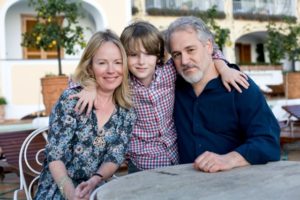
Having a mother was not so easy or uncomplicated. My mother was beautiful and tempestuous. She seethed with a constant rage, like a bubbling cauldron threatening to spill over at any moment. She loved me but she also hated me, and I could feel that hate — that sense that I had taken something valuable and essential from her by my very existence. She competed with me and was envious of me. She certainly did not want me to surpass her. As I write these words I want to erase them — to erase the ugliness of them — but I can’t because they’re the truth, and digging for that truth is what has saved me.

Still, on this day, I mourn her. I mourn what never was, what couldn’t be, and the waste of it all. We’re here for such a brief time. We can reach toward each other or away from each other. We can fill our hearts with kindness or with bile. Some of it is a choice and some of it isn’t. But on this day — on every day, but this one in particular — I want to wish something for all of us, whether we’re motherless, mothers ourselves, or would prefer not to think about any of this mother stuff. Let’s try to be good to each other, and be good to ourselves. This go-round is what we’ve got. My mother missed it. I’m trying like hell not to.
On the Whirlwind
I’ve been doing my best to meditate for twenty minutes each morning These twenty minutes are always essential, but now more than ever as my life kicks into high gear due to the publication of Hourglass. My mind — hungry, searching, grasping, anxious, hopeful, eager, comparing, nervous, scanning the future — needs all the help it can get. It’s easy to get caught up in stuff I can’t control. To attempt to micromanage the universe. And, as we know, the universe doesn’t respond so well to micromanaging.
This morning, as I sat in my little room, the house quiet, my husband downstairs in his office, the fluffy white dog sleeping by the closed door, I had the vision of myself sitting on the edge of a cliff. It wasn’t a scary cliff. The jagged edge, the precipitous drop didn’t feel ominous in my vision. Instead, I felt lashed by the weather. I sat still as a statue as the wind howled, the rain pelted me. I welcomed it. This too, this too, this too. When faced with a whirlwind, there are only two options, it seems to me. Fight it, or ride it.
I have spent too much of my life afraid. Thinking small. Keeping my dreams manageable, making sure not to ask or hope for too much. This stance was self-protective, adaptive. If we don’t dream big, we won’t get hurt, or so this way of thinking goes. A week ago, my husband and I were still in Italy, walking the steep winding paths of Capri with friends. The next day was my birthday, and it was a day full of joy. We basked in the afternoon sun in Ravello, and talked about real things, big things, some painful things, surrounded by staggering beauty, as we ate the most delicious food and drank the palest rosé. This too, this too, this too. The thing about birthdays, and about publications, is they are markers — a way of reminding us that time is passing. Are we seizing the moment by living inside of it — by being fully present for whatever is?

Sometimes when I sit silently in the mornings, I feel tears pricking my eyelids. The deep welling of a lived life rising within me. All the beauty, all the terror. This is where I want to stay — right here in the dead center of my inner life as the whirlwind does what it will, what it must.
On Not Knowing
I recently hung a piece of artwork in my office, made my my friend Debbie Millman. In a simple black frame, matted in white is a large page of what looks to be notepaper, and written in Debbie’s wonderful script in a corner of the notepaper are these words:
this, just this, I am comfortable not knowing.
All lower case, and in the corner, as if the artist is whispering, even though her hand is strong.

I bought the piece on a whim. I had been having trouble working in my office. In fact, I had been having trouble spending time in my office at all. Some inner shifts in my psyche had made it difficult to write in the place where I have always written. And so I had moved my whole operation downstairs to our library, where I have spent the last number of months curled in a big chair, my laptop on my lap. (A masseuse recently asked me if my work station was ergonomically correct and I burst out laughing.) I have been comforted by the thousands of books that surround me in the library, and the view of fields spreading out in the distance. But still, whenever I have been in my office, my eye falls on Debbie’s piece:
this, just this, I am comfortable not knowing.
I have spent my life wanting to know. Needing to know. Love, health, success, happiness – I have grasped at these the way we all do, thinking that if I only do just the right thing, think hard enough, do well enough, I can will all my desires into being. So why, then, do I feel a a profound sense of comfort each time I glance at Debbie’s words? comfortable. not knowing.
This afternoon I unrolled my yoga mat for the first time in a very long time. Something about these inward shifts in my psyche, along with a shoulder injury, have made it difficult to practice each day the way I have for nearly twenty years. And so when I stood on my mat and began my practice, there were poses I couldn’t do. My body didn’t want to twist quite so far, my hands most definitely did not wish to meet in namaste behind my back. I did manage to stand on my head, but my shoulder twinged and I thought better of it. My practice definitely was not pretty. I was glad there was no mirror in which I would see just how out of alignment I really was. But do you know what? As I continued to move through the asanas, as I listened to new music on Spotify, as the fire crackled in the fireplace, it occurred to me that this was the yoga. this, just this.
Nothing, not a single thing in my life, has happened the way I thought it would, the way I thought it should. Actually, scratch that. Some things have gone the way I thought they should — at the time — and those have always been my greatest mistakes, er, opportunities to learn. Marriage, motherhood, my writing life, my teaching life, my closest friendships, my house in the country – each of these grew out of not knowing.
That little word – comfortable — strikes me as the key. That softening. That ease. Days pass, years vanish, and we walk sightless among miracles. My favorite Sabbath prayer. If I can continue to open my eyes to what is – this, just this – I will not miss the miracles. None of us will. And even though the news is grim, the world is haywire, and life is relentlessly challenging, miracles are always everywhere.
On Doing What We Can
During the past several days I have started to write a post, and then stopped. Started, then stopped. And I’ll tell you exactly the thought process, verbatim, that has raced through my mind each time I sat down to write. Who cares? Why me? How can writing possibly help with the state of the world is in such profound chaos? What makes me think I have anything to contribute? Isn’t writing somehow self-indulgent? Shouldn’t I be out there in the world, at every possible waking moment, making some sort of real difference?
Sound familiar? I have felt this way twice before in my writing life. The first time was when my son was terribly sick as an infant with a rare disease, and the odds were stacked against him. Each day, as he slept, I sat in my office and stared at the wall. Why be a writer? I asked myself. It seemed the most frivolous thing I could imagine. People were out there going to medical school, or becoming nurses, or developing experimental treatments that saved lives. And what was I doing? Making things up. I stayed stuck for a good long while. I stayed stuck until one day, while having coffee with a writer friend, I was talking about my terror about my son, and she said: write about that. And so I did. I wrote an essay, and then a novel, about maternal anxiety. It was all I cared about. All I knew about. I poured my heart and soul onto the page because that’s what I am and that’s what I do. Which is to say, I am a writer. I’m not a doctor, a nurse, a scientist. I’m a writer, and a writer writes.
The second time I stared at a wall for a long time was after 9/11. Every artist and writer I knew was doing the same. How to create, from inside the devastation and the madness? How to make meaning when all felt meaningless? We walked around, shadow selves, ghost-like, as we attempted to metabolize a level of collective pain and trauma that seemed impossible to absorb. During that time, William Faulnker’s Nobel acceptance speech was circulated, sent from writer to writer, pressed from hand to hand, a reminder to get back to work despite fear, despite terror, despite a sense of futility. Get back to work. “There are no longer problems of the spirit,” Faulkner rails against precisely that sense of futility. “There is only the question, when will I be blown up?”
Problems of the spirit. It seems to me that this is what writes grapple with every single day when we sit down to work.
Love and honor and pity and pride and compassion and sacrifice.
Which is not to say that I am not filled to the brim with a sense of moral outrage and that every cell in my body does wish to protest during these dark, dark days. I’m doing what I can in that regard — as we all must. But there is another kind of protest, another way of refusing to succumb to despair. And so we sit down to write. We ignore the inner voice telling us that there’s no point, it doesn’t matter. We grapple with the problems of the spirit, of the human heart and all it contains. It matters more than ever.
On Living in the Present
Whenever I’m in the yoga pose of Warrior II, I think about finding that elusive balance between the past and the future. Lean back, and we find ourselves mired in what has already happened. Regret, remorse, guilt, sorrow, grief — whatever the emotional residue may be, we go there. We go there again and again, even though going there changes nothing.
Notice I say “we.” I’m distancing myself even as I write, moving away from the “I” and from the welter of feelings that arise when I attempt to tell the truth of myself.
So then: I.
When I lean forward, into the future, I am also off-balance, out of alignment. Hope, fear, excitement, anxiety, grasping — I go there too. I go there again and again, even though going there also changes nothing. I cannot control the future any more than I can change the past. All I can do is be present. But I shy away from the present because the present is full of terrible ambiguity. It changes from moment to moment to moment. Breathe in, breathe out, and all is changing. If I don’t know what’s going to happen next, and if I can’t make sense of what has already happened, then where is the ground of the present? And if the present is groundless, what is there to hold onto? What are these tears just behind my eyes?
It has been a hard year. We’re all ready to see it go. (There I go again!) The world is a newly alien, terrifying place. There is such a collective sense of grief and loss – and also of community and gathering. Personally it has been a year of enormous challenges. Many days I’ve felt overwhelmed to the point of numbness and despair. And so when it came time to write this last post of the year, I’ve found myself starting and stopping, writing and deleting, thinking that most toxic of thoughts, at least for a writer: I have nothing to say. The truth is that I am spilling over with so much to say that the words start dueling with each other. This is a year in which I have learned more about shock, loss, grief, secrets, heritage, strength, kindness, courage, family, home, and above all, the ways the human heart can stretch and enlarge to accommodate new truths. I’ve learned that I am surrounded by enormously loving people who will catch me if I fall, if only I am strong enough to let them. This is counter intuitive, I know. It takes strength to say: I’m hurting. Strength to say: I’m vulnerable. I’m fragile. This is hard. This is too much to bear. But the moment I do, I find I am given just what I need.
And so, my friends, I wish every single one of you the gift of presence. To quote Mary Oliver: “And that is just the point: how the world, moist and bountiful, calls to each of us to make a new and serious response. That’s the big question, the one the world throws at you every morning. ‘Here you are, alive. Would you like to make a comment?'”
Happy Hannukah, Merry Christmas, and a peaceful 2017 to us all.
On Being Singular
Lately I’ve started each morning by reading for a while before turning to my own work, spurred by Jane Kenyon’s beautiful instruction: keep good sentences in your ears. A day that begins with reading – as is also true of a day that begins with meditation – will inevitably lead to more internal spaciousness. Just yesterday I pulled Elizabeth Tallent‘s masterful collection Mendocino Fire from my pile. A few pages into the first story, I came upon these good sentences:
“This was life then, this bravery, this scaredness, this love of the truth in your possession, the thing you had seen that set you apart and somehow was you. You and no one else.”
You and no one else. I spent a lot of my early life trying hard to fit in. Most kids do. And because we are, each of us, singular, this is a futile, disheartening battle, this work of attempting to be just like everybody else. When I was a little girl who didn’t fit in at the yeshiva, I believed the problem was me. When I was a slightly older girl who didn’t fit in at the prep school, I was certain the problem was me. I spent part of my well-documented twenties careening from man to man, trying to define myself not by who I was (since I was the problem) but by who I was with. Finally, finally, I landed in my thirties and began to untangle this sense that there was something wrong with me, something that needed fixing, and once that thing was fixed, I would feel like I belonged.
I remember — well into my life as a writer, having published four, five, six books — turning to my husband one day and saying: but who are my role models? I couldn’t point to a writer who had taken my exact path. Who moved between fiction and memoir, who wrote a spiritual memoir, who shifted from academic teaching to leading retreats. I wanted to fashion myself after someone instead of hewing ever-more-closely to myself.
Finally — one of the greatest gifts that comes with having been around for a while – I think I’m beginning to get it. This was life then. The thing you had seen that set you apart. When I bring a new book, story, essay into the world, when I give a speech or lead a retreat, I am reporting from the front of the thing I have seen. The thing that sets me apart. Each of us is as individual as a snowflake. Each of us is set apart. It is in all of our individuality, in the sum total of our life experiences, the specificity of our paths, that we have most to offer one another.
Or as that great literary icon Dolly Parton once said: Find out who you are, and do it on purpose.